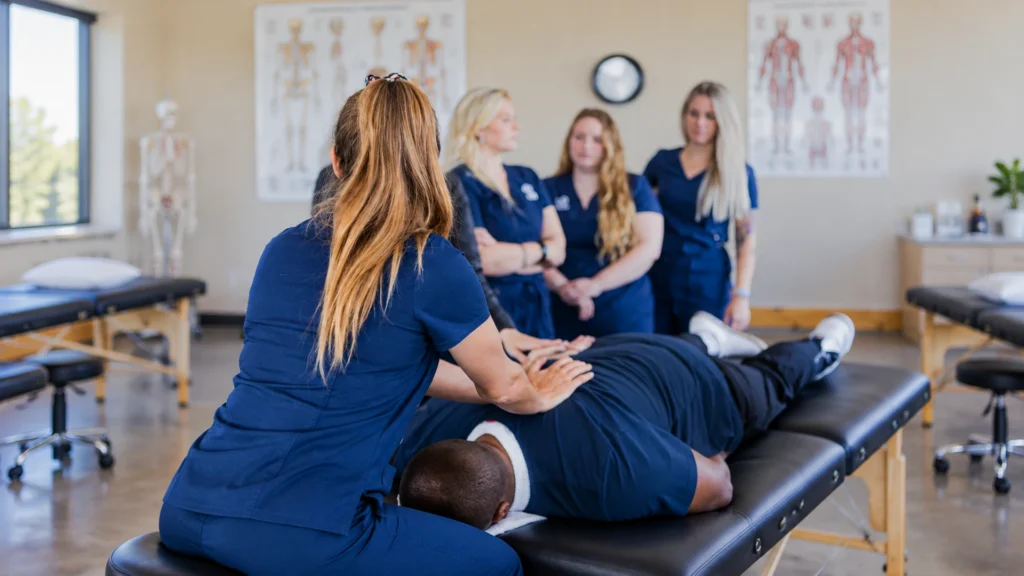
Massage Therapy
Build clinical massage therapy skills through hands-on training and client care.
Request Info
Fill in the form below and we will contact you as soon as possible.
Not a Canadian citizen or permanent resident? Use the international form
Canadian citizen or permanent resident? Use the domestic form
CMTCA Accreditation
Eastern College’s Massage Therapy programs have CMTCA accreditation at all campuses. The curriculum combines clinical learning, professional practice, treatment planning, and exam preparation to support graduates pursuing provincial regulatory requirements. Visit https://www.cmtca.ca/accredited-programs for more information.
About the Program
Develop practical massage therapy skills through anatomy, physiology, pathology, assessment, treatment planning, hydrotherapy, ethics, and clinical practice. Experience an engaging learning environment guided by top-tier instructors and enhance your skills through immersive clinical internships. In addition, our programs are the only CMTCA accredited Massage Therapy Programs in New Brunswick and Nova Scotia.
Curriculum & Program Details
Program Details
- Develop clinical massage therapy skills through hands-on learning, client assessment, treatment planning, and supervised care.
- Gain 440 hours of clinical experience through 360 hours of student clinic and 80 hours of community outreach.
- Build knowledge in anatomy and pathophysiology, massage techniques, hydrotherapy, remedial exercise, ethics, and advanced treatments.
- Prepare for regulatory exams through mock MCQ and OSCE assessments, while learning the fundamentals of massage therapy.
- Program recognized by the MTANS, ANBMT, NBMA, and NLMTA
Program Fees
Fees shown for Fredericton, Saint John, Moncton. Select a location above to see fees for other options.
| Fees | Year 1 | Year 2 | Total |
|---|---|---|---|
| Tuition | $13,371.00 | $12,209.00 | $25,580.00 |
| Supplies | $787.75 | — | $787.75 |
| Digital Learning Resources | $1,024.00 | $935.00 | $1,959.00 |
| Student Protection Fee | $133.71 | $122.09 | $255.80 |
| Total Domestic Tuition and Fees | $15,316.46 | $13,266.09 | $28,582.55 |
| International Student Fee International students only, in addition to the total above | $3,343.00 | $3,052.00 | $6,395.00 |
Price displayed reflects current domestic tuition and includes applicable taxes and ancillary fees. Pricing is subject to change. Fees may vary for out of province and international students.
Pricing above is valid for all domestic students for programs that start before March 31, 2027.
| Fees | Year 1 | Year 2 | Total |
|---|---|---|---|
| Tuition | $12,040.00 | $12,040.00 | $24,080.00 |
| Total Domestic Tuition and Fees | $12,040.00 | $12,040.00 | $24,080.00 |
| International Student Fee International students only, in addition to the total above | $3,492.00 | $3,491.00 | $6,983.00 |
Price displayed reflects current domestic tuition and includes applicable taxes and ancillary fees. Pricing is subject to change. Fees may vary for out of province and international students.
Pricing above is valid for all domestic students for programs that start before March 31, 2027.
Course Listing: New Brunswick
-
Career Planning and Preparation – Level 2 20 hours
This module builds on concepts and skills introduced in the Career Planning and Preparation Level 1 module. In this subsequent module, you will update and refine your résumé and LinkedIn Profile. You will continue writing cover letters and learn the value of customizing cover letters to specific job postings. You will have the opportunity to apply this knowledge as you conduct a job search and write a cover letter tailored to an ideal job post. Through research, you will create a list of top employers and target current industry opportunities. You will learn about current methods for applying to job postings using technology. You will also gain an understanding of the job interview process, typical interview questions and possible responses, and expectations of both the interviewer and interviewee. In addition, you will engage in practical application of the interview process through role-play. Topics such as negotiating salary, self-management, and on-the-job success for placements and post-graduate employment will also be covered.
-
Student Success Strategies 20 hours
In this orientation module, you will focus on achieving success from day one. You will develop non-technical skills to enhance your personal, academic, and career success. You will explore learning styles, including visual, auditory, and kinesthetic learning. You will also enhance your practical study skills, such as memory, reading, note- and test-taking techniques. Personal exercises will focus on teamwork, decision-making and problem-solving skills, setting SMART goals, and maintaining a positive attitude. You will also explore techniques for managing change, stress, and conflict.
-
Career Planning and Preparation – Level 1 20 hours
This course will introduce you to and provide practice in using the tools required for a successful job search. The concepts covered in this course will help you maintain a career-focused approach throughout your studies so that you are better prepared to conduct a job search after graduating. Specifically, you will learn how to identify your soft and hard skills and how to articulate your abilities in a clear and concise Elevator Pitch that will appeal to employers and resonate with industry contacts. You will learn about the job search resources available to you including using career websites, creating LinkedIn profiles, accessing the “hidden” job market, and networking. You will examine sample résumés and cover letters and begin the process of creating your own professional résumés and cover letters that align with current conventions for content, organization, and formatting. You will also learn about the role of references, thank you letters, workplace philosophies, and strategies for success including maintaining a professional image and using proper etiquette when communicating with potential employers and industry contacts. An introduction to Occupational Health and Safety is also provided with specific focus on employees’ rights and responsibilities, workplace health and safety policy and programs, and hazard identification and control.
-
Digital Literacy for Professionals 20 hours
This course introduces essential concepts and principles for navigating and working in a digital environment. Key topics include using devices, managing information, creating and editing content, communicating and collaborating with digital tools, and ensuring online safety and responsibility. You will also apply best practices for folder organization and file naming conventions.
-
Anatomy and Pathophysiology – Arthrology 100 hours
In this course, you will build upon your current knowledge of the Skeletal System to include joints. You will begin to learn how to develop competent and safe treatment plans for some common joint pathologies. You will be able to explain basic joint anatomy and treat all major joints with techniques called joint mobilizations.
-
Anatomy and Pathophysiology – Cardiovascular System 40 hours
This course will cover foundational knowledge of the anatomy, physiology, and pathology of the cardiovascular system. You will be able to identify conditions that are indicated for treatment or may require adaptation while considering precautions, modifications, or contraindications.
-
Anatomy and Pathophysiology – Digestive System 32 hours
This course will cover foundational knowledge of the anatomy, physiology, and pathology of the digestive system and its role in homeostasis. You will evaluate how pathological conditions affect treatment planning and adaptations. You will practice health history questions related to commonly occurring conditions of the digestive system.
-
Anatomy and Pathophysiology – Endocrine System 32 hours
This course will cover foundational knowledge of the anatomy, physiology, and pathology of the endocrine system and its role in homeostasis. You will examine the pathology of diabetes and other endocrine conditions as well as the potential complications and massage implications. You will learn about the body’s response to stress and the implications for treatment planning.
-
Anatomy and Pathophysiology – Integumentary System 20 hours
This course will cover foundational knowledge of the anatomy, physiology, and pathology of the integumentary system. You will gain an understanding of the definition, etiology/pathogenesis, clinical manifestations, treatment, and complications of skin conditions. You will be able to define the stages of epidermal and deep wound healing. You will explore possible infectious skin conditions and their preventions.
-
Anatomy and Pathophysiology – Lymphatic System 32 hours
This course will cover foundational knowledge of the anatomy, physiology, and pathology of the lymphatic and immune system. You will be able to identify conditions that are indicated for treatment or may require adaptation while considering precautions, modifications, or contraindications.
-
Anatomy and Pathophysiology – Muscular System 1 80 hours
This course will cover foundational knowledge of the anatomy, physiology, and pathology of the muscular system. You will gain an understanding of the definition, etiology/pathogenesis, clinical manifestations, treatment, and complications of muscular conditions in the upper body. Muscle attachments, actions, nerve innervation, and palpation of the muscles of the upper body are included within this module. You will be able to identify the origin, insertion, action, and trigger points of the muscles of the upper body.
-
Anatomy and Pathophysiology – Muscular System 2 60 hours
This course builds upon skills and knowledge obtained in Anatomy and Pathophysiology – Muscular System 1. You will continue on the foundational knowledge of the anatomy, physiology, and pathology of the muscular system. You will gain an understanding of the definition, etiology/pathogenesis, clinical manifestations, treatment, and complications of muscular conditions in the lower body. Muscle attachments, actions, nerve innervation, and palpation of the muscles of the lower body are included within this module. You will be able to identify the origin, insertion, action, and trigger points of the muscles of the lower body.
-
Anatomy and Pathophysiology – Neurological System 100 hours
This course will cover foundational knowledge of the anatomy, physiology, and pathology of the nervous system. You will evaluate how pathological conditions affect treatment planning and adaptations. You will practice health history questions related to commonly occurring conditions of the nervous system.
-
Anatomy and Pathophysiology – Reproductive System 28 hours
This course will cover foundational knowledge of the anatomy, physiology, and pathology of the reproductive system. You will gain an understanding of how development and inheritance contribute to homeostasis. You will be able to identify conditions that are indicated for treatment or may require adaptation while considering precautions, modifications, or contraindications. You will be able to illustrate possible complications and side-effects of pregnancy and how to accommodate them in massage therapy.
-
Anatomy and Pathophysiology – Respiratory System 28 hours
This course will cover foundational knowledge of the anatomy, physiology, and pathology of the respiratory system. You will be able to identify conditions that are indicated for treatment or may require adaptation while considering precautions, modifications, or contraindications. You will be able to develop health history questions for common conditions of the respiratory system. You will be able to identify the massage implications of medication used for common respiratory conditions.
-
Anatomy and Pathophysiology – Skeletal System 68 hours
This course will cover foundational knowledge of the anatomy, physiology, and pathology of the skeletal system. You will gain an understanding of the definition, etiology/pathogenesis, clinical manifestations, treatment, and complications of skeletal conditions. Palpation of the bones and landmarks of the skeletal system are included within this module.
-
Anatomy and Pathophysiology – Urinary System 28 hours
This course will cover foundational knowledge of the anatomy, physiology, and pathology of the urinary system. You will evaluate how pathological conditions affect treatment planning and adaptations. You will practice health history questions related to commonly occurring conditions of the urinary system.
-
Clinical Assessment 1 80 hours
This module introduces the assessment process beginning with the cervical spine and upper body. You will be able to perform assessments techniques that include client interview and intake, vital signs, observation, palpation, range of motion, and special tests of the upper body. You will learn to determine if massage is indicated based on your assessment findings. You will also be able to assess if a client should be referred for urgent or non-urgent medical care. You will gain the skill of integrating the findings of other healthcare professionals into an assessment.
-
Clinical Assessment 2 72 hours
This course is a continuation of the course Clinical Assessments 1. You will continue the assessment process and apply it to the lower body. You will be able to perform assessments techniques that include client interview and intake, vital signs, observation, palpation, range of motion, and special tests of the lower body. You will learn to determine if massage is indicated based on your assessment findings. You will also be able to assess if a client should be referred for urgent or non-urgent medical care. You will gain the skill of integrating the findings of other healthcare professionals into an assessment.
-
Concepts of Business Planning and Managing 1 20 hours
This course will introduce you to the career opportunities available within the massage therapy industry. You will be able to describe business management concepts as well as sustainable business practices relevant to massage therapy. You will develop a business plan outline for a future massage therapy business of your own.
-
Concepts of Business Planning and Managing 2 20 hours
This course reinforces and expands on knowledge gained in the prerequisite Concepts of Business Planning and Managing 1. You will explore business marketing concepts and develop a comprehensive business plan based on the outline created in Concepts of Business Planning and Managing 1. You will also learn how to prepare treatment reports for insurance providers and directly billing common insurance companies.
-
Chemical, Cellular, and Tissue Biology 32 hours
This course will introduce you to the chemical terms and elements of the human body. You will be able to describe the structure and function of body cells and tissues and how to optimise the human body's function. You will also be able to identify the chemical reactions of the human body.
-
Comprehensive Treatment Planning and Assessment 40 hours
This course will employ your critical thinking skills as you assess and treat diverse clients based upon multifactorial case scenarios. You will learn to communicate clearly and professionally as a massage therapist. You will assess clients for specific conditions and pathologies and design a comprehensive treatment plan based on client history, presentation, and assessment findings. You will execute treatment plans while adapting to and accommodating clients' presentation.
-
Ethics & Professionalism 40 hours
This course is designed to train you to apply ethical decision-making within clinical settings. You will be able to identify breaches of professional boundaries and exemplify empathetic client-centred care. You will learn about the importance of professionalism and be able to recognize the role of Scope of Practice and Code of Ethics as a massage therapist.
-
Exam Preparation 20 hours
The purpose of this course is to review the material taught in previous classes in a comprehensive manner to ensure you are confident and safe practitioners. You will be introduced to the content and process of the Objectively Structured Clinical Examination (OSCE) and Multiple Choice Questionnaire (MCQ). You will complete mock OSCE stations efficiently. You will also gain an understanding of the performance indicators tested on the regulatory exams.
-
Hydrotherapy 48 hours
In this course you will implement the therapeutic uses, general effects, and specific properties of water. You will be able to summarize the effects, uses and contraindications of a variety of local and general applications of hot, cold and contrast temperatures. You will be able to demonstrate safe hydrotherapy techniques applications. You will also gain an understanding of the relevant clinical applications of hydrotherapy techniques into massage therapy treatment plans.
-
Kinesiology and Remedial Exercise 88 hours
This course begins with introducing you to the basic concepts of levers and biomechanics of the human body. You will learn to relate the indications, contraindications, precautions, and uses of remedial exercises. You will be able to perform appropriate remedial exercises on a client and assign remedial exercises and home care to a client.
-
Mock Multiple Choice Questionnaire 8 hours
This course will review key theoretical components that will be on the provincial examinations to ensure a safe competent therapist. You will complete a mock Multiple Choice Questionnaire (MCQ) in a manner consistent with the provincial regulatory examinations.
-
Medical Terminology 20 hours
In this course you will learn to recognize common prefixes, word roots, suffixes, and medical abbreviations. You will communicate effectively using medical terminology and plain language. This course will also introduce you to the processes, structural organization, and systems of the body. You will gain an understanding of homeostasis and feedback systems.
-
Massage Techniques 1 88 hours
This course is an introduction to the practical component of the massage therapy program and provides the basis from which clinical skills are developed. You will be able to demonstrate safe and hygienic practices with a massage therapy setting. You will be able to identify indications and contraindications to massage therapy. You will perform introductory massage techniques in an effective manner corresponding to the standards of practice in your province. You will be able to select appropriate massage techniques based on clients goals and condition.
-
Massage Techniques 2 40 hours
This course builds on the lessons learned in Massage Techniques 1. You will perform advanced massage techniques in an effective manner corresponding to the standards of practice in your province. You will continue to demonstrate safe and hygienic practices with a massage therapy setting. You will be able to identify indications and contraindications to massage therapy. You will be able to select appropriate massage techniques based on clients goals and condition.
-
Nutrition 20 hours
This course will introduce you how metabolism and nutrition contributes to homeostasis. You will gain an understanding of the role of a massage therapist in promoting healthy eating and nutrition. You will become familiar with healthy eating as outlined in Canada's Dietary Guideline and food labelling.
-
Mock Objectively Structured Clinical Examination 12 hours
This course will review key oral and practical components in a clinically structured environment to mimic what will be on the provincial examinations and to ensure a safe competent therapist. You will complete the mock Objectively Structured Clinical Examination (OSCE) in a manner consistent with the provincial regulatory examination.
-
Pharmacology 28 hours
This course will introduce you to the basic pharmacology terms and concepts, as well as its relevance to the massage therapy practice. You will gain an understanding of the indications, cautions, mechanism, and side effects of common medications. You will also learn how to modify treatment plans to safely accommodate clients taking common medications.
-
Public Health 20 hours
This course is designed to inform you of the healthcare system in Canada in relation to massage therapy and the role of Public Health in the community and in a clinical setting. You will gain an understanding of common infectious skin diseases as well as pathological terms (such as viruses, bacteria, fungi, parasites, and more). You will also be introduced to the responsibilities of identifying reportable diseases and the importance of sanitation and disinfecting procedures.
-
Effective Research 40 hours
This course will introduce you to basic research and statistical terminology. You will be able to research and recognize clinically relevant and reliable sources related to clinical practice. You will gain an understanding of using research to determine if a treatment or modality may improve patient outcomes or standards of care.
-
Review 1 20 hours
The purpose of this course is to review the material taught in previous classes in a comprehensive manner. You will review how to develop treatment plans based on client goals and conditions. You will look back on how to effectively massage and perform hydrotherapy techniques following standards of practice and massage therapy regulations. You will revise the anatomy, physiology, and pathologies of integumentary, skeletal, and muscular system. You will also recap how to conduct effective assessment of the upper body and palpation. You will also review business management skills relevant to massage therapy
-
Review 2 20 hours
The purpose of this course is to review the material taught in previous classes in a comprehensive manner. You will revise the anatomy, physiology, and pathologies of the reproductive, cardiovascular, and nervous systems. You will recap how to conduct effective assessment of the lower body. You will review how to perform effective massage and remedial exercise techniques following standards of practice and massage therapy regulations.
-
Review 3 20 hours
The purpose of this course is to review the material taught in previous classes in a comprehensive manner. You will revise the anatomy, physiology, and pathologies of the lymphatic, digestive, urinary, respiratory, and endocrine systems. You will practice developing treatment plans based on client goals and conditions. You will recap performing effective treatments addressing client goals, impairments, and conditions. You will review the role of pharmaceutical and nutritional education in massage therapy. You will relook at business management skills related to massage therapy.
-
Advanced Treatments 1 72 hours
You will be able to determine treatment outcomes and choices of massage techniques based on client goals and impairments. You will be able to develop comprehensive massage treatments plans and administer a massage therapy consistent with your treatment plan. You will demonstrate massage treatments that safely accommodate various conditions and pathologies. You will learn how to obtain informed consent and maintain informed consent for treatment plans, including treatment of sensitive areas.
-
Advanced Treatments 2 132 hours
This course will reinforce the lessons learned in Advanced Treatments 1. You will be able to develop comprehensive massage treatments plans and administer a massage therapy consistent with your treatment plan. You will demonstrate massage treatments that safely accommodate various conditions and pathologies. You will learn how to obtain informed consent and maintain informed consent for treatment plans, including treatment of sensitive areas.
-
Regulations and Legislation 32 hours
This course will introduce you to the relevant parts of legislation, regulations, and standards of practice to the practice of massage in your respective province. You will learn how to obtain client consent, client goals, and gather health information to compile client health history. You will be able to identify the role of the regulatory college and that of provincial massage associations.
Course Listing: Nova Scotia
-
Career Planning and Preparation – Level 2 20 hours
This course builds on concepts and skills introduced in the Career Planning and Preparation Level 1 course. In this subsequent course, you will update and refine your résumé and LinkedIn Profile. You will continue writing cover letters and learn the value of customizing cover letters to specific job postings. You will have the opportunity to apply this knowledge as you conduct a job search and write a cover letter tailored to an ideal job post. Through research, you will create a list of top employers and target current industry opportunities. You will learn about current methods for applying to job postings using technology. You will also gain an understanding of the job interview process, typical interview questions and possible responses, and expectations of both the interviewer and interviewee. In addition, you will engage in practical application of the interview process through role-play. Topics such as negotiating salary, self-management, and on-the-job success for placements and post-graduate employment will also be covered.
-
Digital Literacy for Professionals 20 hours
This course introduces essential concepts and principles for navigating and working in a digital environment. Key topics include using devices, managing information, creating and editing content, communicating and collaborating with digital tools, and ensuring online safety and responsibility. You will also apply best practices for folder organization and file naming conventions.
-
Anatomy and Pathophysiology – Arthrology 100 hours
In this course, you will build upon your current knowledge of the Skeletal System to include joints. You will begin to learn how to develop competent and safe treatment plans for some common joint pathologies. You will be able to explain basic joint anatomy and treat all major joints with techniques called joint mobilizations.
-
Anatomy and Pathophysiology – Cardiovascular System 40 hours
This course will cover foundational knowledge of the anatomy, physiology, and pathology of the cardiovascular system. You will be able to identify conditions that are indicated for treatment or may require adaptation while considering precautions, modifications, or contraindications.
-
Anatomy and Pathophysiology – Digestive System 32 hours
This course will cover foundational knowledge of the anatomy, physiology, and pathology of the digestive system and its role in homeostasis. You will evaluate how pathological conditions affect treatment planning and adaptations. You will practice health history questions related to commonly occurring conditions of the digestive system.
-
Anatomy and Pathophysiology – Endocrine System 32 hours
This course will cover foundational knowledge of the anatomy, physiology, and pathology of the endocrine system and its role in homeostasis. You will examine the pathology of diabetes and other endocrine conditions as well as the potential complications and massage implications. You will learn about the body’s response to stress and the implications for treatment planning.
-
Anatomy and Pathophysiology – Integumentary System 20 hours
This course will cover foundational knowledge of the anatomy, physiology, and pathology of the integumentary system. You will gain an understanding of the definition, etiology/pathogenesis, clinical manifestations, treatment, and complications of skin conditions. You will be able to define the stages of epidermal and deep wound healing. You will explore possible infectious skin conditions and their preventions.
-
Anatomy and Pathophysiology – Lymphatic System 32 hours
This course will cover foundational knowledge of the anatomy, physiology, and pathology of the lymphatic and immune system. You will be able to identify conditions that are indicated for treatment or may require adaptation while considering precautions, modifications, or contraindications.
-
Anatomy and Pathophysiology – Muscular System 1 80 hours
This course will cover foundational knowledge of the anatomy, physiology, and pathology of the muscular system. You will gain an understanding of the definition, etiology/pathogenesis, clinical manifestations, treatment, and complications of muscular conditions in the upper body. Muscle attachments, actions, nerve innervation, and palpation of the muscles of the upper body are included within this module. You will be able to identify the origin, insertion, action, and trigger points of the muscles of the upper body.
-
Anatomy and Pathophysiology – Muscular System 2 60 hours
This course builds upon skills and knowledge obtained in Anatomy and Pathophysiology – Muscular System 1. You will continue on the foundational knowledge of the anatomy, physiology, and pathology of the muscular system. You will gain an understanding of the definition, etiology/pathogenesis, clinical manifestations, treatment, and complications of muscular conditions in the lower body. Muscle attachments, actions, nerve innervation, and palpation of the muscles of the lower body are included within this module. You will be able to identify the origin, insertion, action, and trigger points of the muscles of the lower body.
-
Anatomy and Pathophysiology – Neurological System 100 hours
This course will cover foundational knowledge of the anatomy, physiology, and pathology of the nervous system. You will evaluate how pathological conditions affect treatment planning and adaptations. You will practice health history questions related to commonly occurring conditions of the nervous system.
-
Anatomy and Pathophysiology – Reproductive System 28 hours
This course will cover foundational knowledge of the anatomy, physiology, and pathology of the reproductive system. You will gain an understanding of how development and inheritance contribute to homeostasis. You will be able to identify conditions that are indicated for treatment or may require adaptation while considering precautions, modifications, or contraindications. You will be able to illustrate possible complications and side-effects of pregnancy and how to accommodate them in massage therapy.
-
Anatomy and Pathophysiology – Respiratory System 28 hours
This course will cover foundational knowledge of the anatomy, physiology, and pathology of the respiratory system. You will be able to identify conditions that are indicated for treatment or may require adaptation while considering precautions, modifications, or contraindications. You will be able to develop health history questions for common conditions of the respiratory system. You will be able to identify the massage implications of medication used for common respiratory conditions.
-
Anatomy and Pathophysiology – Skeletal System 68 hours
This course will cover foundational knowledge of the anatomy, physiology, and pathology of the skeletal system. You will gain an understanding of the definition, etiology/pathogenesis, clinical manifestations, treatment, and complications of skeletal conditions. Palpation of the bones and landmarks of the skeletal system are included within this module.
-
Anatomy and Pathophysiology – Urinary System 28 hours
This course will cover foundational knowledge of the anatomy, physiology, and pathology of the urinary system. You will evaluate how pathological conditions affect treatment planning and adaptations. You will practice health history questions related to commonly occurring conditions of the urinary system.
-
Clinical Assessment 1 80 hours
This module introduces the assessment process beginning with the cervical spine and upper body. You will be able to perform assessments techniques that include client interview and intake, vital signs, observation, palpation, range of motion, and special tests of the upper body. You will learn to determine if massage is indicated based on your assessment findings. You will also be able to assess if a client should be referred for urgent or non-urgent medical care. You will gain the skill of integrating the findings of other healthcare professionals into an assessment.
-
Clinical Assessment 2 72 hours
This course is a continuation of the course Clinical Assessments 1. You will continue the assessment process and apply it to the lower body. You will be able to perform assessments techniques that include client interview and intake, vital signs, observation, palpation, range of motion, and special tests of the lower body. You will learn to determine if massage is indicated based on your assessment findings. You will also be able to assess if a client should be referred for urgent or non-urgent medical care. You will gain the skill of integrating the findings of other healthcare professionals into an assessment.
-
Concepts of Business Planning and Managing 1 20 hours
This course will introduce you to the career opportunities available within the massage therapy industry. You will be able to describe business management concepts as well as sustainable business practices relevant to massage therapy. You will develop a business plan outline for a future massage therapy business of your own.
-
Concepts of Business Planning and Managing 2 20 hours
This course reinforces and expands on knowledge gained in the prerequisite Concepts of Business Planning and Managing 1. You will explore business marketing concepts and develop a comprehensive business plan based on the outline created in Concepts of Business Planning and Managing 1. You will also learn how to prepare treatment reports for insurance providers and directly billing common insurance companies.
-
Chemical, Cellular, and Tissue Biology 32 hours
This course will introduce you to the chemical terms and elements of the human body. You will be able to describe the structure and function of body cells and tissues and how to optimise the human body's function. You will also be able to identify the chemical reactions of the human body.
-
Comprehensive Treatment Planning and Assessment 40 hours
This course will employ your critical thinking skills as you assess and treat diverse clients based upon multifactorial case scenarios. You will learn to communicate clearly and professionally as a massage therapist. You will assess clients for specific conditions and pathologies and design a comprehensive treatment plan based on client history, presentation, and assessment findings. You will execute treatment plans while adapting to and accommodating clients' presentation.
-
Ethics & Professionalism 40 hours
This course is designed to train you to apply ethical decision-making within clinical settings. You will be able to identify breaches of professional boundaries and exemplify empathetic client-centred care. You will learn about the importance of professionalism and be able to recognize the role of Scope of Practice and Code of Ethics as a massage therapist.
-
Exam Preparation 20 hours
The purpose of this course is to review the material taught in previous classes in a comprehensive manner to ensure you are confident and safe practitioners. You will be introduced to the content and process of the Objectively Structured Clinical Examination (OSCE) and Multiple Choice Questionnaire (MCQ). You will complete mock OSCE stations efficiently. You will also gain an understanding of the performance indicators tested on the regulatory exams.
-
Hydrotherapy 48 hours
In this course you will implement the therapeutic uses, general effects, and specific properties of water. You will be able to summarize the effects, uses and contraindications of a variety of local and general applications of hot, cold and contrast temperatures. You will be able to demonstrate safe hydrotherapy techniques applications. You will also gain an understanding of the relevant clinical applications of hydrotherapy techniques into massage therapy treatment plans.
-
Kinesiology and Remedial Exercise 88 hours
This course begins with introducing you to the basic concepts of levers and biomechanics of the human body. You will learn to relate the indications, contraindications, precautions, and uses of remedial exercises. You will be able to perform appropriate remedial exercises on a client and assign remedial exercises and home care to a client.
-
Mock Multiple Choice Questionnaire 8 hours
This course will review key theoretical components that will be on the provincial examinations to ensure a safe competent therapist. You will complete a mock Multiple Choice Questionnaire (MCQ) in a manner consistent with the provincial regulatory examinations.
-
Medical Terminology 20 hours
In this course you will learn to recognize common prefixes, word roots, suffixes, and medical abbreviations. You will communicate effectively using medical terminology and plain language. This course will also introduce you to the processes, structural organization, and systems of the body. You will gain an understanding of homeostasis and feedback systems.
-
Massage Techniques 1 88 hours
This course is an introduction to the practical component of the massage therapy program and provides the basis from which clinical skills are developed. You will be able to demonstrate safe and hygienic practices with a massage therapy setting. You will be able to identify indications and contraindications to massage therapy. You will perform introductory massage techniques in an effective manner corresponding to the standards of practice in your province. You will be able to select appropriate massage techniques based on clients goals and condition.
-
Massage Techniques 2 40 hours
This course builds on the lessons learned in Massage Techniques 1. You will perform advanced massage techniques in an effective manner corresponding to the standards of practice in your province. You will continue to demonstrate safe and hygienic practices with a massage therapy setting. You will be able to identify indications and contraindications to massage therapy. You will be able to select appropriate massage techniques based on clients goals and condition.
-
Nutrition 20 hours
This course will introduce you how metabolism and nutrition contributes to homeostasis. You will gain an understanding of the role of a massage therapist in promoting healthy eating and nutrition. You will become familiar with healthy eating as outlined in Canada's Dietary Guideline and food labelling.
-
Mock Objectively Structured Clinical Examination 12 hours
This course will review key oral and practical components in a clinically structured environment to mimic what will be on the provincial examinations and to ensure a safe competent therapist. You will complete the mock Objectively Structured Clinical Examination (OSCE) in a manner consistent with the provincial regulatory examination.
-
Pharmacology 28 hours
This course will introduce you to the basic pharmacology terms and concepts, as well as its relevance to the massage therapy practice. You will gain an understanding of the indications, cautions, mechanism, and side effects of common medications. You will also learn how to modify treatment plans to safely accommodate clients taking common medications.
-
Public Health 20 hours
This course is designed to inform you of the healthcare system in Canada in relation to massage therapy and the role of Public Health in the community and in a clinical setting. You will gain an understanding of common infectious skin diseases as well as pathological terms (such as viruses, bacteria, fungi, parasites, and more). You will also be introduced to the responsibilities of identifying reportable diseases and the importance of sanitation and disinfecting procedures.
-
Regulations and Legislation 32 hours
This course will introduce you to the relevant parts of legislation, regulations, and standards of practice to the practice of massage in your respective province. You will learn how to obtain client consent, client goals, and gather health information to compile client health history. You will be able to identify the role of the regulatory college and that of provincial massage associations.
-
Effective Research 40 hours
This course will introduce you to basic research and statistical terminology. You will be able to research and recognize clinically relevant and reliable sources related to clinical practice. You will gain an understanding of using research to determine if a treatment or modality may improve patient outcomes or standards of care.
-
Review 1 20 hours
The purpose of this course is to review the material taught in previous classes in a comprehensive manner. You will review how to develop treatment plans based on client goals and conditions. You will look back on how to effectively massage and perform hydrotherapy techniques following standards of practice and massage therapy regulations. You will revise the anatomy, physiology, and pathologies of integumentary, skeletal, and muscular system. You will also recap how to conduct effective assessment of the upper body and palpation. You will also review business management skills relevant to massage therapy
-
Review 2 20 hours
The purpose of this course is to review the material taught in previous classes in a comprehensive manner. You will revise the anatomy, physiology, and pathologies of the reproductive, cardiovascular, and nervous systems. You will recap how to conduct effective assessment of the lower body. You will review how to perform effective massage and remedial exercise techniques following standards of practice and massage therapy regulations.
-
Review 3 20 hours
The purpose of this course is to review the material taught in previous classes in a comprehensive manner. You will revise the anatomy, physiology, and pathologies of the lymphatic, digestive, urinary, respiratory, and endocrine systems. You will practice developing treatment plans based on client goals and conditions. You will recap performing effective treatments addressing client goals, impairments, and conditions. You will review the role of pharmaceutical and nutritional education in massage therapy. You will relook at business management skills related to massage therapy.
-
Advanced Treatments 1 72 hours
You will be able to determine treatment outcomes and choices of massage techniques based on client goals and impairments. You will be able to develop comprehensive massage treatments plans and administer a massage therapy consistent with your treatment plan. You will demonstrate massage treatments that safely accommodate various conditions and pathologies. You will learn how to obtain informed consent and maintain informed consent for treatment plans, including treatment of sensitive areas.
-
Advanced Treatments 2 132 hours
This course will reinforce the lessons learned in Advanced Treatments 1. You will be able to develop comprehensive massage treatments plans and administer a massage therapy consistent with your treatment plan. You will demonstrate massage treatments that safely accommodate various conditions and pathologies. You will learn how to obtain informed consent and maintain informed consent for treatment plans, including treatment of sensitive areas.
Admission Requirements
On-Campus (New Brunswick)
- Student has Grade 12 or equivalent or meets criteria for Mature Student Status.
- Mature students must be 19 years of age, pass a qualifying test, and provide a Letter of Intent OR resume that supports their skills and aptitudes to be successful in the program.
- The approved qualifying test for this program is the Wonderlic test. A passing score for this program is 14.
- Student must provide a clear Criminal Record Check.
- Student must provide a clear Vulnerable Sector Check.
- Student must provide proof of completion of Eastern College pre-Science Course, or its equivalent (Grade 11 or 12 Biology, or first-year university Kinesiology course).
- Student must provide proof of experiencing a full body massage, either from the Eastern Massage Therapy Clinic, or from a Registered Massage Therapist from an outside clinic.
On-Campus (Nova Scotia)
- Student has Grade 12 or equivalent, OR can pass a qualifying test.
- The approved qualifying test for this program is the Wonderlic test. A passing score for this program is 14.
- Student must provide a clear Criminal Record Check.
- Student must provide a clear Vulnerable Sector Check.
- Student must provide proof of completion of Eastern College pre-Science Course, or its equivalent (Grade 11 or 12 Biology, or first-year university Kinesiology course).
- Student must provide proof of experiencing a full body massage, either from the Eastern Massage Therapy Clinic or from a member of the Massage Therapist Association of Nova Scotia at an outside clinic.

I love Massage Therapy because it’s a profession where clients are almost always very happy to see you, and leave feeling even better. It’s a profession with considerable autonomy too, as Massage Therapists, along with their clients, design their own treatment plans and implement them. Most workplaces make a flexible work schedule possible, and the environment during a massage treatment is usually slow-paced and comfortable; a great atmosphere to go to work in!
Instructor Quote
Darcy Chiasson
Massage Therapy Instructor
Hear from Graduates
Frequently asked questions
What skills will I build beyond massage techniques?
You will learn clinical assessment, evidence-informed treatment planning, anatomy and pathophysiology, remedial exercise, professional communication, consent, ethics, and client-centred care. The program also teaches professional charting and the standards expected in massage therapy practice.
How much hands-on clinical experience will I get?
You will complete 440 hours of supervised clinical experience, including 360 hours in the student clinic and 80 hours of community outreach. Students generally begin working with public clients after building the foundational knowledge and practical skills needed for clinic practice.
What does a typical week in the Massage Therapy program look like?
Students generally attend four hours of class each weekday and usually study two courses at a time, combining theory and practical learning. Once clinic begins, students typically complete a six-hour supervised clinic shift each week. Exact schedules vary by campus and intake.
How does the program prepare me for professional registration after graduation?
The program includes review courses, dedicated exam preparation, a mock MCQ, and a mock OSCE to reinforce the knowledge and practical skills used in entry-to-practice assessment. In New Brunswick, graduates must successfully complete CMTNB registration examinations and meet the College’s other registration requirements before becoming an RMT.
Will I learn the business side of massage therapy?
Yes. You will learn about practice management, business planning, marketing, financial considerations, professional responsibilities, and working as an employee, independent contractor, or clinic owner.