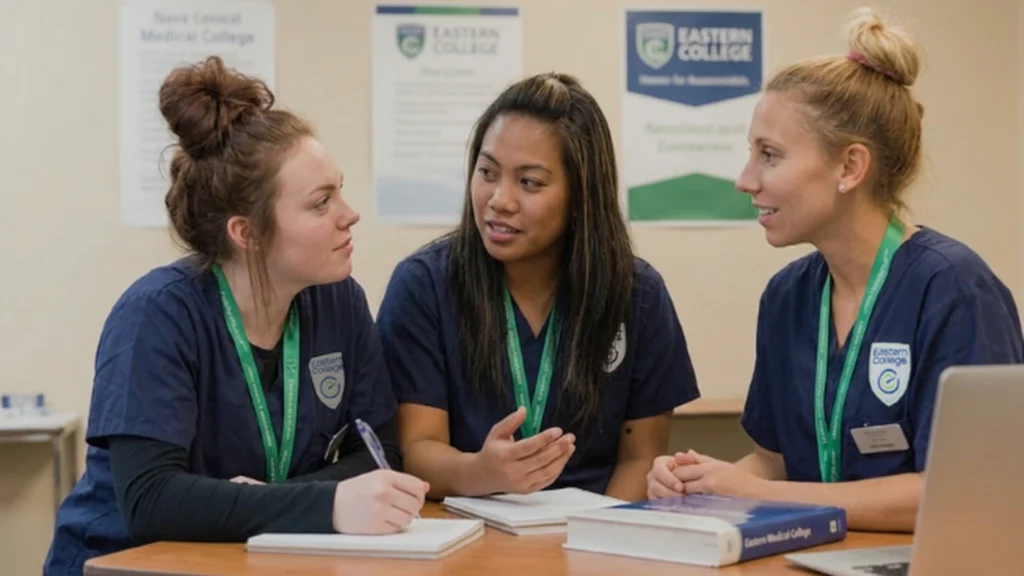
Personal Support Worker
Build hands-on personal care skills to support clients across healthcare settings.
Request Info
Fill in the form below and we will contact you as soon as possible.
Not a Canadian citizen or permanent resident? Use the international form
Canadian citizen or permanent resident? Use the domestic form
NACC Accreditation
Eastern College’s NACC Personal Support Worker 2022 program is accredited by the National Association of Career Colleges (NACC). Students also complete Standard First Aid/CPR and Gentle Persuasive Approaches training and prepare for the NACC PSW Final Examination.
About the Program
Build practical skills in personal care, mobility, nutrition, medication assistance, infection prevention, documentation, and mental health support. Practice safe, compassionate, person-centered care through skills labs and supervised clinical placements.
New Brunswick Immigration Pathway Reopened and Now Available for Future Eastern College Graduates
The Government of New Brunswick, in partnership with Immigration, Refugees and Citizenship Canada (IRCC), has extended the New Brunswick Private Career College Graduation Pilot and granted dedicated seats for Eastern College graduates of 2026.
If you enroll now in one of our upcoming Personal Support Worker (PSW) programs, you’ll graduate in 2026 and be eligible to apply directly to this re-opened immigration pathway.
Curriculum & Program Details
Program Details
- Build practical Personal Support Worker skills for safe, compassionate, person-centered care.
- Practice personal care, mobility and transfers, nutrition, infection prevention, medication assistance, documentation, and mental health and dementia support.
- Learn acute care, palliative care, and community care practices.
- Complete a 12-week clinical placement in healthcare settings.
Program Fees
Fees shown for Fredericton, Saint John, Moncton. Select a location above to see fees for other options.
| Fees | Amount |
|---|---|
| Tuition | $9,670.00 |
| Supplies | $759.00 |
| Digital Learning Resources | $263.00 |
| Student Protection Fee | $96.70 |
| Total Domestic Tuition and Fees | $10,788.70 |
| International Student Fee International students only, in addition to the total above | $3,111.00 |
Additional Fees
- Additional Printing Credits: $5.00.
- Photocopying: $0.10/page.
- Copy of Student File to Third Party: $125.00.
- NSF cheque or NSF EFT fee: $25.00.
- Replacement/Additional Official Transcript or Diploma: $25.00.
- Replacement Student ID: $5.00.
- Replacement Student Lanyard: $5.00.
- Lost/Missing Elevator Key replacement: $50.00.
- A fee may be charged equal to the value of any Eastern College equipment that is lent to a student, then not returned.
- Challenge Exam: $50.00.
- Prior Learning Assessment Recognition (PLAR) Fee: $100.00.
- General Course Retake Fee: $100.00 (first retake attempt only). The full course cost may be charged for additional course retakes (additional fees for some courses may apply as listed below).
- Personal Support Worker Missed Clinical Practicum Hours: $300 per day.
- Personal Support Worker NACC Rewrite Exam: $115.00 plus tax.
- Remarking Fee (Grade Appeal): $50.00.
- Extra healthcare program Uniform: $75.00.
- If a student requests that any documents are sent to them by courier, then the courier fee is to be reimbursed. There is no delivery charge for documentation if picked up at the campus, sent by regular mail within Canada or sent electronically.
- Health insurance is included in tuition and international fees for international students until 7 days after their regularly scheduled end date. A fee may be charged to extend health insurance coverage if the student's end date is extended.
- International student family member health insurance may be offered for sale to any international student who has family members staying in Canada with them while they are studying.
- There may occasionally be a transportation fee charged for any optional field trips or events. Field trips and events that are part of the student's program are free.
- Interest may be charged on outstanding student accounts balances owing after a student is no longer in school. No interest is charged on student accounts while a student is attending school.
- Parking may be offered for sale at some campuses.
- A fee for students and/or guests may be charged for graduation ceremonies and/or gown rental. (No fee to receive diploma).
Price displayed reflects current domestic tuition and includes applicable taxes and ancillary fees. Pricing is subject to change. Fees may vary for out of province and international students.
Pricing above is valid for all domestic students for programs that start before March 31, 2027.
| Fees | Amount |
|---|---|
| Tuition | $9,670.00 |
| Supplies | $759.00 |
| Digital Learning Resources | $263.00 |
| Student Protection Fee | $96.70 |
| Total Domestic Tuition and Fees | $10,788.70 |
| International Student Fee International students only, in addition to the total above | $3,111.00 |
Additional Fees
- Copy of Student File to Third Party: $125.00.
- NSF cheque or NSF EFT fee: $25.00.
- Replacement/Additional Official Transcript or Diploma: $25.00.
- A fee may be charged equal to the value of any equipment that is lent to a student, then not returned.
- Challenge Exam: $50.00.
- Prior Learning Assessment Recognition (PLAR) Fee: $100.00.
- General Course Retake Fee: $100.00 (first retake attempt only). The full course cost may be charged for additional course retakes (additional fees for some courses may apply as listed below).
- Personal Support Worker Missed Clinical Practicum Hours: $300 per day.
- Personal Support Worker NACC Rewrite Exam: $115.00 plus tax.
- Remarking Fee (Grade Appeal): $50.00.
- Extra healthcare program Uniform: $75.00.
- If a student requests that any documents are sent to them by courier, then the courier fee is to be reimbursed. There is no delivery charge for documentation if picked up at the campus, sent by regular mail within Canada or sent electronically.
- Voucher Exam Retake fees are charged at standard voucher pricing.
- Health insurance is included in tuition and international fees for international students until 7 days after their regularly scheduled end date. A fee may be charged to extend health insurance coverage if the student's end date is extended.
- International student family member health insurance may be offered for sale to any international student who has family members staying in Canada with them while they are studying.
- Interest may be charged on outstanding student accounts balances owing after a student is no longer in school. No interest is charged on student accounts while a student is attending school.
- EduPay extended financing may be offered. There is a $75 administration fee; no interest is charged while the student is in school; and interest is charged on balances owing after school. All fees and interest are waived if a student pays in full before the end of their program.
- A fee for students and/or guests may be charged for graduation ceremonies and/or gown rental. (No fee to receive diploma).
Price displayed reflects current domestic tuition and includes applicable taxes and ancillary fees. Pricing is subject to change. Fees may vary for out of province and international students.
Pricing above is valid for all domestic students for programs that start before March 31, 2027.
Course Listing: New Brunswick
-
CPR and First Aid/WHMIS 24 hours
Upon successful completion of this course, students will achieve the Standard Level First Aid and Healthcare Provider (BLS-Basic Life Support) Level CPR. Participants are guided to fully understand responsive behaviours in order to be able to respond effectively and appropriately in a workplace setting. Upon successful completion of this course, students will achieve the Standard Level First Aid and Healthcare Provider (BLS-Basic Life Support) Level CPR.
-
Student Success Strategies 20 hours
In this orientation module, you will focus on achieving success from day one. You will develop non-technical skills to enhance your personal, academic, and career success. You will explore learning styles, including visual, auditory, and kinesthetic learning. You will also enhance your practical study skills, such as memory, reading, note- and test-taking techniques. Personal exercises will focus on teamwork, decision-making and problem-solving skills, setting SMART goals, and maintaining a positive attitude. You will also explore techniques for managing change, stress, and conflict.
-
Career Management 20 hours
Our Career Management program introduces students to the strategies and components of an effective job search, including self-marketing and awareness, skills inventory, job search tools and the job market. The Career Management course is delivered by our on-campus Career Services Team who are there throughout the job search to assist and mentor students towards achieving their ultimate goal of employment in their field of study. Our Team of Career Services Professionals maintain relationships in their communities with key employers and organizations that recognize the value Eastern College graduates have to offer. The skills learned throughout Career Management at Eastern College will continue to serve students in their job search as they navigate their new careers.
-
Abuse and Neglect 15 hours
This module introduces students to the concepts of violence and abuse, including its possible signs, and the appropriate actions and legal requirements if abuse is suspected. Personal beliefs and attitudes about family violence and abuse are examined, as is the concept of worker abuse of the client and, abuse of the worker. PSW will learn to recognize both indicators and causes, and the requirements of legislation, employer policy, and provisions of the service contract or support plan.
-
Body Systems 40 hours
This module will introduce the student to the basics of anatomy and physiology. Students will gain an understanding of human body systems in order to apply that knowledge in their daily work as a Personal Support Worker. These body systems are the musculoskeletal, digestive, urinary, integumentary, reproductive, cardiovascular, respiratory, nervous, and endocrine. Common disorders and age-related changes for each body system will also be covered.
-
Care Planning, Restorative Care, Documentation, Working in the Community 30 hours
This module identifies the support provided through the care plan or service contract to the client to relearn or regain routine abilities. They will understand its significance, and the rights of the client as a receiver of support and the purpose, methods, and persons involved in its creation. Student will also be introduced to working in the community health care environment, providing support to patients and families in communities, conducted in accordance with employer guidelines.
-
Cognitive and Mental Health Issues and Brain Injuries 40 hours
This module introduces students to common psychiatric conditions such as affective disorders, schizophrenia, substance abuse, cognitive impairment, and brain injury. The possibility of multiple conditions such as Alzheimer’s disease and depression will be discussed along with the role of the family caregiver and the importance of observation, documentation, and reporting in order to recognize changes in behaviour that can be related to psychiatric conditions or an increased risk of suicide.
-
Assisting the Dying Person 30 hours
In this module students learn about hospice, palliative and end-of-life care, the integration of a palliative approach to care, ways of being, communication and practical strategies to provide psychosocial support and physical comfort care for both the person and their family. This module addresses provincial palliative care competencies (2018-2020) including competencies for caring for First Nation, Inuit, Metis and urban Indigenous peoples.
-
Assisting the Family, Growth and Development 25 hours
Students learn to understand family characteristics in terms of structure, functions, roles, lifestyles and relationships. The influence of cultural values, practices, religious beliefs as well as the effects of illness, stress, and disability on family relationships will be emphasized as central to the PSW’s ability to provide effective support. This module also explores the stages of growth and development throughout the life cycle and the role of the PSW in providing respite to families.
-
PSW Foundations 55 hours
The introductory module provides an overview of the scope of responsibilities of PSWs in a variety of settings. Students will learn about client-centered versus client-directed care; and emphasizing the individuality of the client and his/her relationship with family, friends and others. Key topics include work relationships, stress and time management, interpersonal skills and communications, including conflict resolution and problem solving, and applicable legislation.
-
Gentle Persuasive Approaches in Dementia Care 10 hours
Gentle Persuasive Approaches (GPA) is a multi-disciplinary program designed for everyone who interacts with older adults in the workplace. Participants are guided to fully understand responsive behaviors in order to be able to respond effectively and appropriately in a workplace setting.
-
Health Conditions 40 hours
Students are introduced to ongoing conditions and basic concepts of assistance, as well as the general effects on the person of common disabilities, conditions and diseases. Students will gain skill in the necessary techniques while focusing on the importance of providing support safely, effectively and comfortably. Concepts of maintenance, rehabilitation and restoration are discussed, as is the importance of the support team in providing assistance and training of these additional skills.
-
Assisting with Personal Hygiene 30 hours
PSW’s assist clients with all activities or routines of daily living. Students will learn how to care for the ill, disabled, injured and/or confused client. Frailness, dignity and levels of dependence will be considered. Personal hygiene includes oral care, perineal care, bathing, grooming, dressing, bed making, shaving, hair care, and skin care. It includes mobility considerations and involves personal safety, self-esteem and dignity. The foundation of this module is humanistic health care.
-
Clinical Placement (Facility) 200 hours
Clinical placement provides students with an opportunity to practice their new skills in a work setting. Students gain experience in a wider range of PSW skills, become more self-confident, and may receive offers of employment from the placement site. They spend time working in a facility setting for 100 hours under the supervision of their instructor and under a preceptor provided by the host site for 100 hours. The instructor will be available by phone and email during the placement.
-
Clinical Placement (Community) 100 hours
Clinical placement provides students with an opportunity to practice their new skills in a work setting. While on placement, students gain experience in a wider range of PSW skills, become more self-confident, and may receive offers of employment from the placement site. In this module the students will spend time working in a community setting under the supervision of a preceptor provided by the host site. The instructor will be available by phone and email at all times.
-
Assisting with Medications 20 hours
Within the PSW scope of practice, students learn about medication administration versus assistance. They gain basic knowledge of the drugs used in the treatment of common diseases and disorders including use, classification, effects, and routes of administration. They identify purposes, required instruction, and cautions; and the importance of observation for both desired and undesired outcomes, as well as the procedures to be followed in the event of a concern or problem with medications.
-
Household Management, Nutrition and Hydration 25 hours
Students will learn to assist the client with their nutritional needs, household activities, and household management according to client preferences, comfort and safety within employer guidelines as required. Nutritional needs include planning balanced menus, preparing shopping lists and shopping, safe handling of food, and storage and specific cooking techniques. The special dietary needs of certain clients and their cultural and religious preferences will all be addressed.
-
Safety and Mobility 40 hours
The second module covers safety as it relates to both the client and the worker. One of the fundamental activities of the PSW is that of assisting the client with routine activities of living. Students will learn about risks of unsafe equipment or settings and appropriate actions to take when unsafe situations are identified. Topics include infection control methods, body mechanics, and transferring and lifting techniques using equipment to increase safety and reduce client anxiety.
-
Acute Care for Personal Support Worker 80 hours
This provides you with the additional knowledge and skills you need to support clients in the acute care hospital setting. You will learn to assist the health care team with measuring height, weight and vital signs, heat and cold applications, meeting client oxygen needs, physical examinations, peri-operative care, medications and enteral nutrition, IV therapy. You will also learn urinary and fecal elimination and wound care.
-
NACC PSW Exam 10 hours
In this module, students are prepared for writing the final NACC exam, through a comprehensive review of the two sets of Final Exam Evolve Questions, (approximately 319 questions). After the review session, they write the final NACC exam. Students must pass this final exam in order to work as a Personal Support Worker in the field.
Admission Requirements
- Student has Grade 12 or equivalent or meets criteria for Mature Student Status.
- Mature students must be 19 years of age, pass a qualifying test, and provide a Letter of Intent OR resume that supports their skills and aptitudes to be successful in the program.
- The approved qualifying test for this program is the Wonderlic test. A passing score for this program is 11.
- Student must provide a current clear Canada wide Police Clearance of Criminal Record with Vulnerable Sector screening within 45 days of the commencement of study.
- Student must provide a Clear Medical Certificate within 45 days of the commencement of study.
- If English is not a student’s first language, they must provide proof of English competency. English Language Proficiency Requirements are: 1) IELTS – Int’l English Language Testing Services – Minimum score of 6.0 with no subject test score lower than 5.5; OR 2) TOEFL – Test of English as a Foreign Language Internet based test (IBT) – Overall 80 with the minimum in each component: Reading 20; Listening 20; Speaking 20; Writing 20; OR 3) CAEL: Overall 60 No section below 60; OR 4) Canadian English Language Proficiency Index Program (CELPIP) General with a score of 7 (no section score below 6); OR 5) Canadian Language Benchmark Tests with a score of 7 in each strand (not an average of 7); OR 6) Duolingo English Test with a minimum score of 105; OR 7) Pearson PTE Academic with a minimum score of 46; OR 8) NACC Written Entrance Exam (passing score of 60); OR 9) Evidence of successful completion of 2 consecutive years of full-time equivalent post-secondary study in English at a Canadian institution; OR 10) Evidence of successful completion of 2 consecutive years of full-time equivalent post-secondary study in English at an institution outside of Canada
- .

“I love seeing students build confidence, compassion, and practical skills to care for others with dignity and respect.”
Program Coordinator Quote
Divya Kuruvila
Program Coordinator
Hear from Graduates
What will I learn in the Personal Support Worker program?
You will build skills in personal care, mobility and transfers, infection prevention, nutrition, mental health and dementia support, documentation, communication, and client safety. Training also focuses on dignity, independence, compassion, and person centered care.
Will I get hands on PSW training?
Yes. In person students practice essential caregiving skills in supervised skills labs before applying their learning during clinical placements. Training includes personal care, safe transfers and positioning, mobility support, observation, documentation, and other day to day PSW responsibilities.
What certifications and training are included?
Students prepare for the NACC Final Examination and complete training that includes Standard First Aid and CPR, Gentle Persuasive Approaches for dementia care, and other workplace safety requirements. Successful completion of the program and NACC Final Examination leads to the NACC PSW certificate.
What should I expect during my clinical placement?
Clinical placements give you experience providing care in professional healthcare settings. Placements may include early mornings, evenings, weekends, or shift work, and students are expected to demonstrate strong attendance, communication, professionalism, and safe care practices.
What is it like to work as a Personal Support Worker?
Personal Support Work can be both physically and emotionally demanding. You may assist with mobility, personal care, dementia support, illness, and end of life care, so compassion, resilience, communication, and professionalism are important parts of the role.